The Floor Is Dropping

One of Stellar's top salespeople rang me up yesterday about an inbound opportunity — high-impact AEO/GEO work for a small but mighty brand we'd be excited to take on. The catch was the price point: too small for it to make economic sense for us. Six months ago, the conversation would have ended there, with a referral somewhere else if possible. Now, the math works. AI can absorb the bulk of the standard actions, reporting, and (increasingly) communications that make small accounts challenging from a margin standpoint, which lets our team spend the time it actually needs on strategy and edge cases. In this specific case, our SEO team will use Visibility for content automation, digital PR, and technical analysis, putting all of it through their expert lens. The brand gets agency-grade work it couldn't otherwise afford. We get an account we couldn't otherwise serve. Win-win.
That kind of decision used to be a reflex no. It's becoming a reflex yes — and the second-order consequences of that shift are just starting to emerge.
The floor
Every agency has a floor: a minimum account size below which servicing the relationship does not make enough profit. The floor is driven mostly by human cost — the senior strategist's hour, the standing meeting, the deck preparation, the reporting cadence — all the things that have to happen on any account, even one too small to absorb them. Above that floor, you keep the client. Below it, you either say no, refer them out, or do mediocre work. I've seen agencies do all three.
For a fast-growing agency, the floor isn't just a margin guardrail. It's also a tax on growth. Every "no" to inbound is lost revenue, but it's also lost market presence, lost referrals, and lost reps in a category. None of that shows up in the unit economics, but the opportunity cost compounds quietly in the background.
What's actually moving
The work that historically priced small accounts out — the meetings, decks, reporting, daily in-platform optimization, the standing hum that runs underneath every account — is exactly the work our Pixis-driven agents are absorbing first. Senior human time doesn't disappear in this transition. It gets concentrated on the things that actually compound: strategy, judgment, edge cases, and the bets that move a brand. Which is to say the floor isn't going away. It's just relocating, and it's relocating downward.
The asymmetry no one is naming
This is the part the AI-cost-compression narrative misses entirely. Below the floor, brands weren't getting a watered-down version of an agency — they weren't getting an agency at all. They were piecing together their marketing from YouTube how-tos, a friend who happens to work at a real agency on nights and weekends, or one of the fly-by-night shops that prey on the bottom of the market. We come across those shops constantly when we're prospecting, and the work they produce isn't professionalized service. It's something else entirely.
So when the floor drops, the brands picked up at the bottom aren't getting a cheaper version of an agency. They're getting a professional agency for the first time. That's a different kind of win-win — not a discount, but an upgrade in category.
And the AEO/GEO opportunity is the cleanest version of the pattern I've seen so far: a service that only exists because of AI, delivered economically to a brand that can only afford it because of AI. Both ends of the relationship are AI-shaped. Six months from now this probably won't feel novel anymore, but right now it does.
Both directions, not one
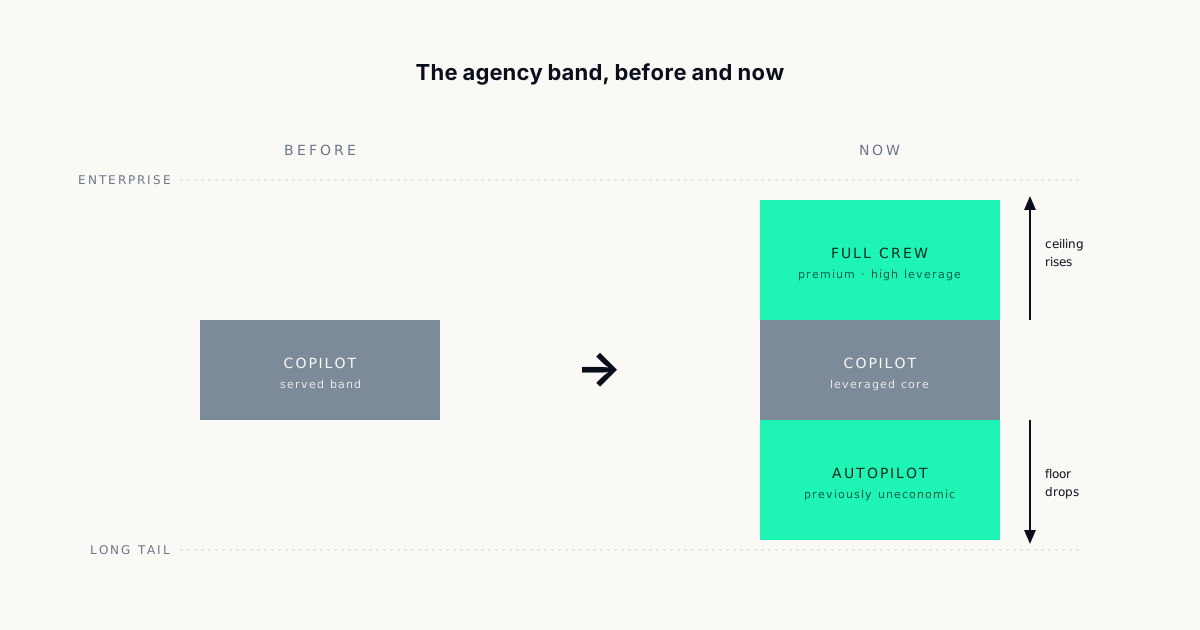
Most coverage of AI in marketing assumes the move is up-market. AI lets agencies serve enterprise clients with more leverage, more depth, more specialization. That part is true — but it's only half the picture. The floor drops at the same time the ceiling rises, and most agencies will only choose to play in one of those directions at a time.
The real opening is the full spectrum.
At Stellar, we're productizing this explicitly with three tiers: Autopilot, Copilot, and Full Crew. Autopilot is nearly entirely agent-led, and it's the offering that opens up the previously uneconomic tail of the market. Copilot is the leveraged core, where humans lead the relationship and agents handle the standing hum underneath. Full Crew is the most complex way for us to work: a senior-heavy team operating at high leverage on top of a fleet of agents working in the background. Same agency, three loadouts depending on what the client actually needs.
What this means for an agency's TAM is that it doesn't just expand downward. It expands at both ends. The floor is moving, and so is the ceiling I hope :-)