Renaming is Not Rebuilding

We acquire agencies and transform them.
Most people read the word transformation and picture a private-equity playbook — a fixed set of plays, executed in sequence, finished in eighteen months. That's not what this is. We sit inside a fast-moving technology company. New models, new agents, new tools land on the team every few weeks. The transformation plan is a living thing. What's possible to do this quarter wasn't possible last quarter, and won't be the same thing next quarter.
We're the ones doing the rebuild, using our own technology. And from inside that work, you start noticing how much AI transformation talk out in the market — in marketing trade press, vendor pitches, peer announcements, adjacent industries — describes something that isn't actually a rebuild. It's a rename.
The vocabulary is identical. The way you tell them apart is structural, and the test runs before any work happens — at the proposal stage.
What rebuilt looks like in the plan
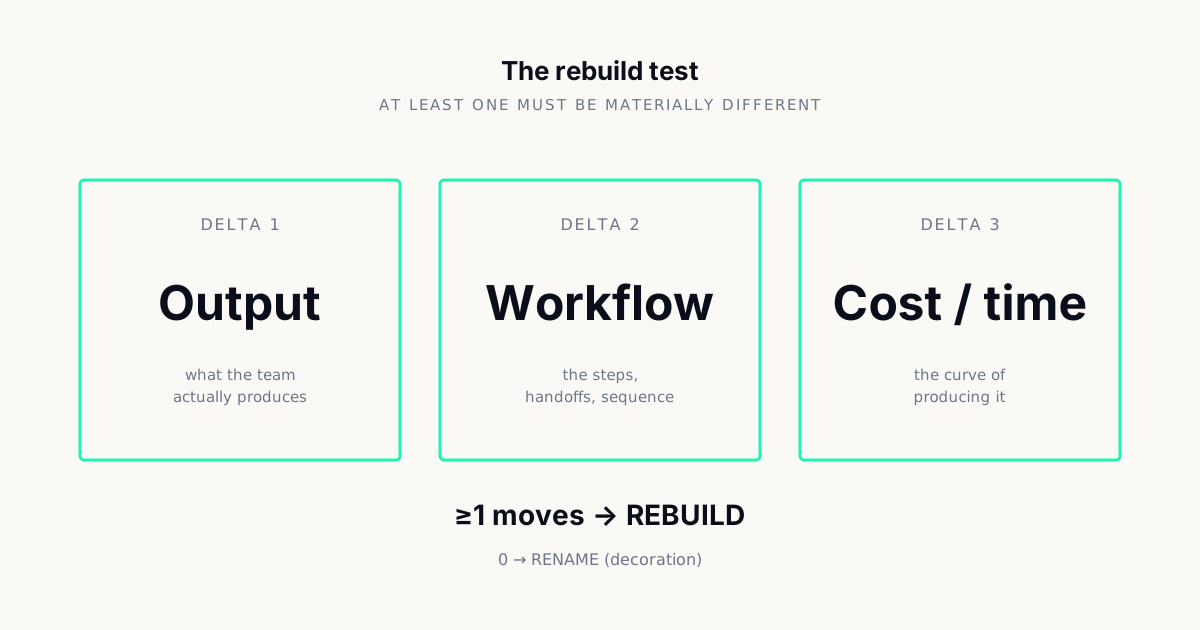
A rebuild describes a structural delta you can point at. At least one of three things has to be materially different from the starting state, and the plan has to say how:
- the output the team produces
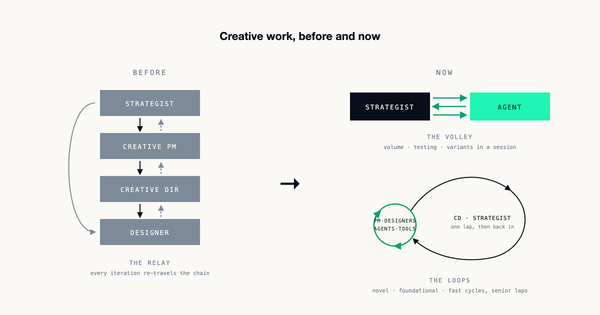
- the workflow that produces it — the steps, the handoffs, what happens at each step
- the cost or time curve of producing it
If none of those is moving, it's not a rebuild. The rest of the document is decoration.
What renaming actually looks like
Most of the AI transformation talk we see in the market lands in one of these patterns. The obvious version is changing a team's name. "Creative" becomes "AI Creative Pod." That one gets caught.
The harder versions all read like AI work, and they pass casual review:
- Personnel shuffle, no workflow change. A team gets reorganized. Same steps, same outputs as last quarter.
- Tool swap, same workflow. "AI tool X replaces tool Y." Humans still run the same steps in the same order with the same handoffs. The tool changed; the work didn't.
- Process labels, same process. Steps got renamed — "agentic ideation," "AI-augmented planning." Read the steps. They're unchanged.
- New titles, same deliverables. "AI Producer" replaces "Producer." Same brief, same cycle time, same output.
- A siloed pilot. An "AI experiment" is launched, scoped so it can't touch the main delivery line. No structural change, by design.
The pattern is the same across all of them: surface activity, no structural delta. You can call it before any work happens.
The exception worth defending
There's one rename worth doing on purpose. Sometimes you know the workflow has to move or the cost or time has to come down and you know it's possible in one of many ways – you just don't know which one you'll land on. Renaming first, in that case, is the move that makes the rebuild happen. You commit to the new name publicly, the old way of operating gets harder to defend, and the team works toward the new shape because it has to.
The commitment usually only needs to be public inside the company. Occasionally it's external, which is harder to walk back, but you don't need to go that far for it to work.
What separates this from theater is whether the rebuild is on a calendar. Without that, the rename is just the destination.
What we look for
Output, workflow, cost. Look there and you'll know.