Relationship Inertia: The Variable AWS Didn't Have to Fight

Andy Jassy said something this week worth sitting with:
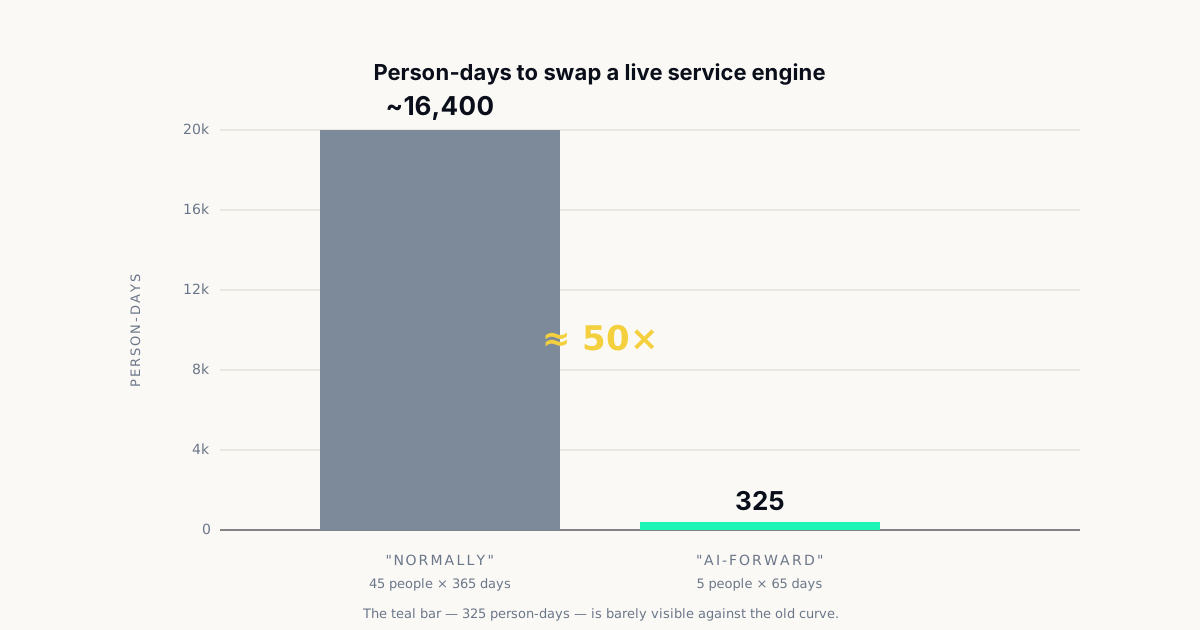
"If you look at one of our services, we swapped out the engine of the service while we were also running the service full tilt. Normally, that would have taken 40 or 50 people about a year to do. We took five really smart, AI-forward-thinking people building on agentic coding tools, and those five people rebuilt it in 65 days."
Five people. Sixty-five days. Work that used to need forty.
I keep seeing this pattern in the field over the past year, with clients and internally at our agencies. It isn't rare anymore — but it is binary. Operators are either AI-obsessed or they aren't. There's almost no one in the middle. The obsessed ones compound; the rest fall behind faster than they realize.
Where the pattern lands cleanly is everywhere a customer isn't watching. AWS could rebuild a live service's engine because no client was tracking the size of the engineering team. Same for most back office work — though if you ask your billing or contracts or legal team how clean the swap actually is, you'll find they live in the middle. Their inputs are internal; their outputs land on a client desk.
Where it hits a wall is everywhere a customer is watching — and watching a person.
Agencies are the canonical case. Law, consulting, wealth management, anything sold on "meet your team, work with our experts." Over time, clients don't equate results with the strategy or the SOPs or the team underneath. They equate results with the expert. The work and the person fuse. Strip the visible touch, and perceived value drops, even when actual results hold or improve. Call this Relationship Inertia. It's the variable AWS didn't have to fight.
One nuance the framework hides: in performance marketing, the real experts aren't the ones being replaced by AI. They're the ones leaning into it.
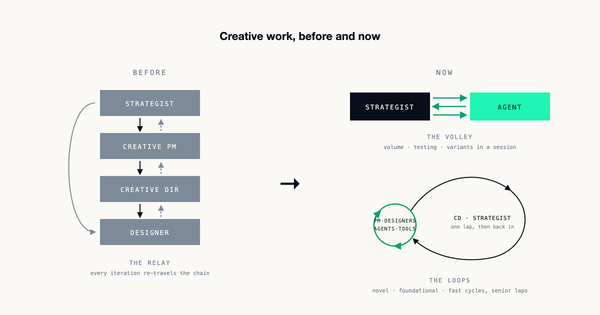
The work that gets automated — trafficking, daily optimization, pivot-table reporting, creative fatigue detection, budget allocation between platforms, meeting notes — is the work that kept them from doing the work they're actually expert at. Translating performance into a business narrative. Choosing which bets are worth doubling down on. Knowing when to redefine what "winning" looks like for a brand instead of chasing this quarter's CAC. Pushing a client to be bolder than they would have been on their own. That work stays with the human. Pulling that human further from the client would have a real impact.
The deployment paradox makes it harder from both sides.
When performance is winning, that's the cleanest technical moment to deploy AI — strategies are known, guardrails are obvious, you're replicating proven plays. It's also when clients hit peak risk-aversion. Don't touch what's working.
When performance is behind expectations, you most need new tools. But you've burned the social capital to propose them. The client wants accountability, not "let's try something new."
So there's no clean announcing window. You never get the permission slip.
Which means you stop asking. What's working at Stellar isn't an announcement — it's a demonstration. Reporting gets auto-generated. Daily optimization gets handled by Prism. Pivot tables are replaced with realtime dashboards and prompt-based deep reporting. Ad trafficking is automated right from Prism itself. Meeting notes and follow-ups are handled by Polaris — an internal copilot built for client-facing teams to absorb the low- and no-value-add work. The conversation, after the fact, is: "You'll see a little less of me — and we shipped X, Y, Z this quarter we couldn't have shipped before, because I'm able to spend time and effort there instead of on work now done by agents."
The list of automated and agentic work is the proof. And it only lands once it's already proof.
The AWS transition is the easy one. The harder transition is the agency that figures out how to hold a client relationship while quietly replacing the work that used to define it. The agencies that figure that out first reset the category – Stellar's already in that group.